_edited.png)
A Mars Hill Moment: Evangelical Engagement in the Age of Al

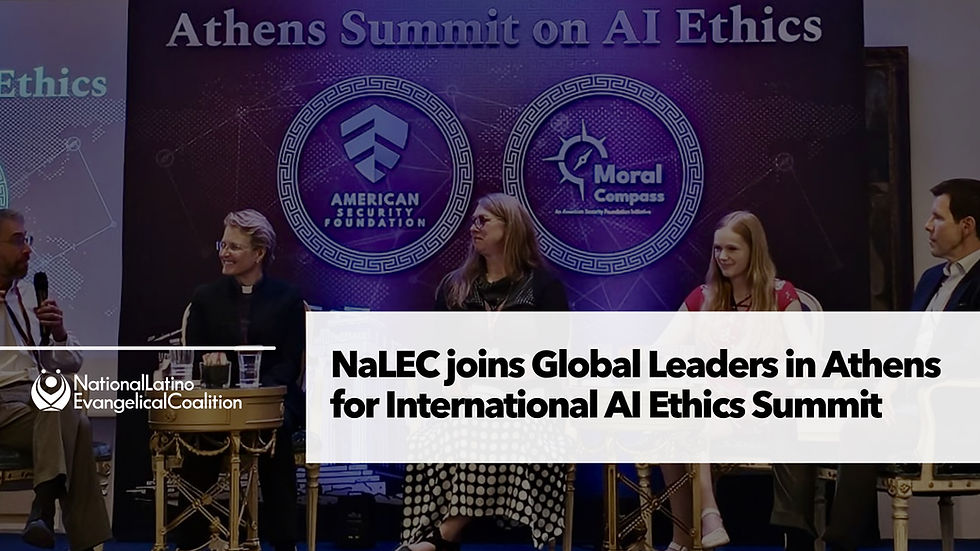
Jeanette and I visited Mars Hill in Athens this week, the site of the Apostle Paul’s sermon, following a three-day Faith and AI Ethics Summit in the birthplace of Western democracy and philosophy. Standing on those ancient stones, I could not help but reflect on the profound significance of Paul’s engagement with the dominant intellectual currents of his day. In his sermon on “The Unknown God,” Paul did not retreat from the philosophical debates surrounding him. He fully engaged the Epicureans and Stoics, entering directly into the moral and spiritual questions shaping the culture of Athens.
Just as Paul engaged the prevailing philosophies and challenges of his age, contemporary evangelicals must resist the temptation to run from the defining questions of our own moment.
From a deeply Gospel-centered foundation, we are called to engage both the promises and the perils of emerging technologies, including the rapidly developing world of artificial intelligence. Fearful disengagement has never been the Christian calling, faithful engagement has.
One of the greatest hurdles facing evangelicalism today is what Carl F. H. Henry lamented decades ago: the loss of “apostolic passion,” a confidence in a faith capable of transforming the world. Sadly, much of American evangelicalism has exchanged this apostolic, global-changing vision for what I would describe as an “anxious global-fearing retrenchment.” This retreat is rooted in a siege ecclesiology that interprets nearly every cultural disagreement, intellectual challenge, or social engagement as evidence that Christianity itself is under attack.
Yet Paul’s sermon at Mars Hill stands in sharp contrast to this posture of fear. His engagement precedes Tertullian’s famous early third-century question, “What indeed has Athens to do with Jerusalem?” While Tertullian warned against undue pagan influence on Christian thought, the broader Christian tradition, from Paul to Augustine to Aquinas, demonstrates that serious engagement with culture, philosophy, and intellectual inquiry need not weaken Christian conviction. On the contrary, the appropriate response to the challenges of any age is not anxious retrenchment but a deeply formed and intellectually serious faith capable of wise and discerning engagement. An apostolic posture, one rooted in the conviction that followers of Christ are called to participate in the transformation of the world, cannot be held captive by a fearful anxiety that retreats from a society desperately searching for morally grounded and spiritually rooted answers.
We are living through one of the most consequential technological moments in human history. Artificial intelligence is already reshaping economics, labor, education, medicine, communication, warfare, governance, and even our understanding of what it means to be human.
Too often, contemporary evangelical discourse oscillates between uncritical technological triumphalism and fearful cultural withdrawal. Neither response is adequate. Christians are called neither to baptize every innovation nor to abandon the public square. We are called to discernment grounded in wisdom, courage, theological depth, and missional imagination.
This moment requires a dialectical engagement that places three realities into deep conversation: Christian wisdom, the humanities, and the modern technological moment.
Christian wisdom offers moral grounding. The Christian tradition provides centuries of reflection on human dignity, moral responsibility, justice, virtue, community, sin, and flourishing. In an age where efficiency and optimization increasingly dominate public discourse, Christian theology reminds us that human beings are not merely data points, consumers, or programmable systems. We are image bearers of God endowed with sacred worth and moral agency.
The humanities provide historical memory and moral imagination. Literature, philosophy, history, ethics, and the arts cultivate the capacity to ask not only what can be built, but what should be built. The humanities remind us that technological advancement without moral formation can produce societies that are highly efficient and profoundly dehumanizing. A technologically advanced society devoid of transcendent moral vision risks confusing innovation and information with wisdom.
The modern technological moment demands engagement rather than retreat. AI is not a distant abstraction. It is shaping how children learn, how governments govern, how corporations operate, how wars are fought, and how truth itself is mediated.
Evangelicals cannot afford to stand at the sidelines issuing condemnations without contributing moral seriousness, theological reflection, and constructive vision.
This is precisely why apostolic passion matters.
Paul did not flee Athens because it was intellectually pluralistic. He entered it. He reasoned. He listened. He engaged. He challenged idolatry while also affirming truths wherever he found them. His confidence was rooted not in fear of cultural contamination but in confidence in the truth and transformative power of the Gospel.
What if this is a modern Mars Hill moment?
➡️Continue reading and subscribe on Substack: https://open.substack.com/pub/pastorssalguero/p/a-mars-hill-moment-evangelical-engagement?r=86v76n&utm_medium=ios
🖥️Read in spanish: https://open.substack.com/pub/pastorssalguero/p/nuestro-momemto-areopago-los-evangelicos?r=86v76n&utm_medium=ios